
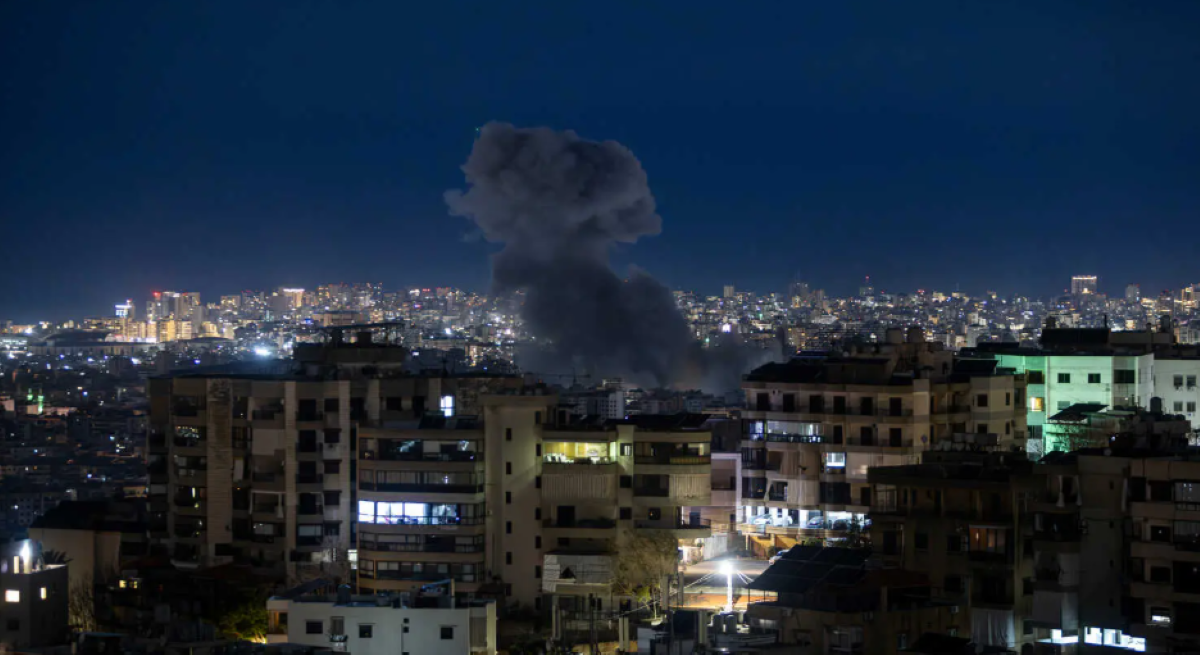
Washington: As the conflict in the Middle East involving the United States, Israel, and Iran intensifies, military activities across the region have significantly escalated. Reports of explosions, missile strikes, drone attacks, and military operations have emerged from the Gulf region to Lebanon, Syria, and Iraq. The conflict is also beginning to affect the global economy and energy supply.
According to journalists from AFP, powerful explosions were heard on Saturday in Dubai and in Manama, the capital of Bahrain. These explosions occurred one week after Iran began retaliatory attacks on targets in the Gulf region. Warning sirens sounded in Manama, and Bahrain’s Interior Ministry urged residents via social media to move to the nearest safe locations.
Meanwhile, the United States Department of State announced that it had granted “emergency” approval for the sale of 12,000 bomb casings to Israel. According to the department’s Bureau of Political–Military Affairs, the proposed sale is expected to strengthen Israel’s defense capabilities, help address current and future threats, and serve as a deterrent against regional dangers.
Following missile attacks launched from Iran, the Israel Defense Forces issued nationwide air raid warnings. Iran has reportedly been carrying out continuous attacks against Israel in retaliation for the killing of its Supreme Leader, Ali Khamenei, and for joint U.S.–Israeli military operations targeting sites across Iran.
Tensions have also escalated along the Lebanon–Syria border. According to Lebanese state media, clashes occurred after Israel attempted a landing operation in the area. The Tehran-backed group Hezbollah stated that its fighters were involved in the confrontation. Hezbollah had launched missile strikes toward Israel on Monday, claiming retaliation for the killing of Khamenei, after which Israel deployed additional troops to Lebanon.
In the Gulf region, further attack attempts have been reported. The Saudi Arabian Ministry of Defense stated that a ballistic missile aimed at an airbase housing U.S. military personnel was intercepted. The state news agency also reported that a drone attack targeting the Ras Tanura refinery in eastern Saudi Arabia was thwarted, along with another attempted drone strike in oil fields near the border with the United Arab Emirates.
A major explosion was also reported on Saturday in Tehran, the capital of Iran, according to the country’s state broadcaster. Subsequently, the Israeli military confirmed that it had launched “large-scale strikes” against targets in Tehran. Israel stated that a new wave of missile launches from Iran triggered a series of explosions in Tel Aviv.
Israel has also accused Iran of using cluster bombs “multiple times” since the start of the war. These weapons disperse smaller submunitions after exploding in the air, posing long-term risks to civilians. Neither Iran nor Israel is a party to the international convention banning the use and production of cluster munitions.
Meanwhile, the United States has responded to reports that Russia provided intelligence assistance to Iran. The The Washington Post reported, citing U.S. intelligence officials, that Russia had shared information with Iran regarding the locations of U.S. military assets, including ships and aircraft. However, the White House downplayed the issue, with Pentagon chief Pete Hegseth stating that U.S. commanders were fully aware of the situation.
Iran has rejected alleged U.S. involvement in its leadership selection process. U.S. President Donald Trump had stated that he should be involved in selecting a successor to Khamenei. Responding to this, Iran’s ambassador to the United Nations, Amir Saeid Iravani, said that Iran’s leadership selection would follow constitutional procedures and reflect the will of the Iranian people.
As the war intensifies, the United States has also announced plans to increase weapons production. According to President Trump, major U.S. defense companies have agreed to increase production of advanced weapons by up to four times. The U.S. military reported that more than 3,000 targets were struck during the first week of the conflict.
The war is also beginning to impact the global economy. Concerns about disruptions to oil supplies in the Gulf region have pushed crude oil prices sharply higher. The price of West Texas Intermediate crude oil rose by 12 percent on Friday, reaching $90.92 per barrel, marking a significant weekly increase.
Tensions have also risen in Iraq. Rockets targeted the perimeter of Baghdad International Airport, where a military base and U.S. diplomatic facilities are located. A shadowy group called Saraya Awliya al-Dam claimed responsibility for the attack and is believed to be part of the Iran-backed Islamic resistance network.
President Trump also said he would attend the repatriation ceremony for the bodies of six U.S. soldiers killed in an Iranian drone attack in Kuwait. According to him, the soldiers were killed in an attack on the southern industrial hub of Port Shuaiba.
In southern Lebanon, several peacekeepers from Ghana were reportedly injured in an attack on a base belonging to the United Nations Interim Force in Lebanon (UNIFIL). Although the perpetrator remains unclear, intense fighting between Israel and Hezbollah has been ongoing in the area.
Trump has reiterated his demand that Iran must offer an “unconditional surrender” to end the war, promising assistance in rebuilding the country’s economy if it complies. Analysts suggest that this proposal goes far beyond the military objectives previously stated by the United States.
Meanwhile, the Secretary-General of the United Nations, António Guterres, condemned what he described as “illegal attacks” in the Middle East and warned that the war could spiral out of control. He stated that the ongoing crisis is causing severe human suffering and posing serious risks to the global economy.
The conflict is also affecting the vital maritime route known as the Strait of Hormuz. According to marine traffic data analyzed by AFP, only nine oil tankers, cargo ships, and container vessels have passed through the strait since Monday. Under normal circumstances, about 20 percent of the world’s crude oil and 20 percent of liquefied natural gas pass through this route.
France has also increased its military presence in the Mediterranean region. According to the French Armed Forces, a helicopter carrier has been deployed there, and Paris has already decided to send its main aircraft carrier and several frigates to the region.
— RSS / AP








Comments