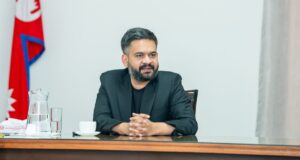
Kathmandu: Medical entrepreneur and activist Durga Prasai has expressed his support for the government’s recent invitation for dialogue but reiterated his belief that Nepal is being deliberately weakened by what he calls a “foreign grand design.”
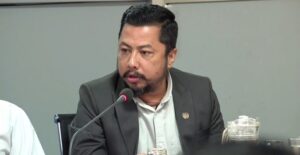
Speaking at a recent editors’ interaction and through social media, Prasai emphasized that his movement is aimed at protecting Nepal’s sovereignty, its citizens, and its cultural values from what he views as a corrupt political and financial system.
Prasai, who leads the National Campaign for the Protection of Nation, Nationality, Religion, Culture, and Citizens, praised the government’s willingness to engage in dialogue, noting that the current administration’s approach shows responsibility—a quality he feels was lacking under the previous government led by former Prime Minister Khadga Prasad Sharma Oli.
“If the government has officially called us for talks, we welcome it,” Prasai said, “But now, what Nepal needs is a genuine solution that ensures the protection of its people and the nation.”
In the same interaction, Prasai accused foreign powers of systematically undermining Nepal’s sovereignty, claiming that outside forces have infiltrated Nepal’s political and economic systems. He pointed to the abolition of the monarchy and the status of Nepal as a Hindu state as part of a broader foreign agenda. “Why did Girija Prasad Koirala often talk about a ‘grand design’? Now, it’s clear—foreign interests aimed to dismantle Nepal’s identity,” Prasai remarked.
Prasai also defended his ongoing campaign against what he describes as exploitative banking practices. Presenting documents to counter claims that his businesses are blacklisted, he stated that his companies are tax-compliant and regularly pay their electricity bills.
His campaign, he explained, is not about evading financial obligations, but about fighting against a system he describes as a “lootocracy.” He highlighted the disparity between promised and actual interest rates, noting that while banks claim to offer 7% interest, they often charge up to 17%, leading to debt traps for ordinary citizens. His protests, he claimed, forced banks to reduce interest rates to 6%, benefiting the wider population.
Prasai also took aim at powerful business conglomerates, accusing them of monopolizing wealth and influence. He pointed to recent fires at key government buildings—Singha Durbar and the Supreme Court—as symbols of the deeper rot in Nepal’s system.
While he expressed gratitude to Kathmandu Mayor Balen Shah for preventing his detention during recent protests, Prasai also criticized the city’s response to the fires, suggesting that firefighters should have focused on extinguishing the flames instead of serving water to demonstrators.
Prasai concluded by affirming that his movement would continue peacefully, with a focus on financial reform, national unity, and the protection of Nepal’s sovereignty. “Talks are welcome,” he said, “But what the people want are tangible results that will safeguard the nation and its people.”