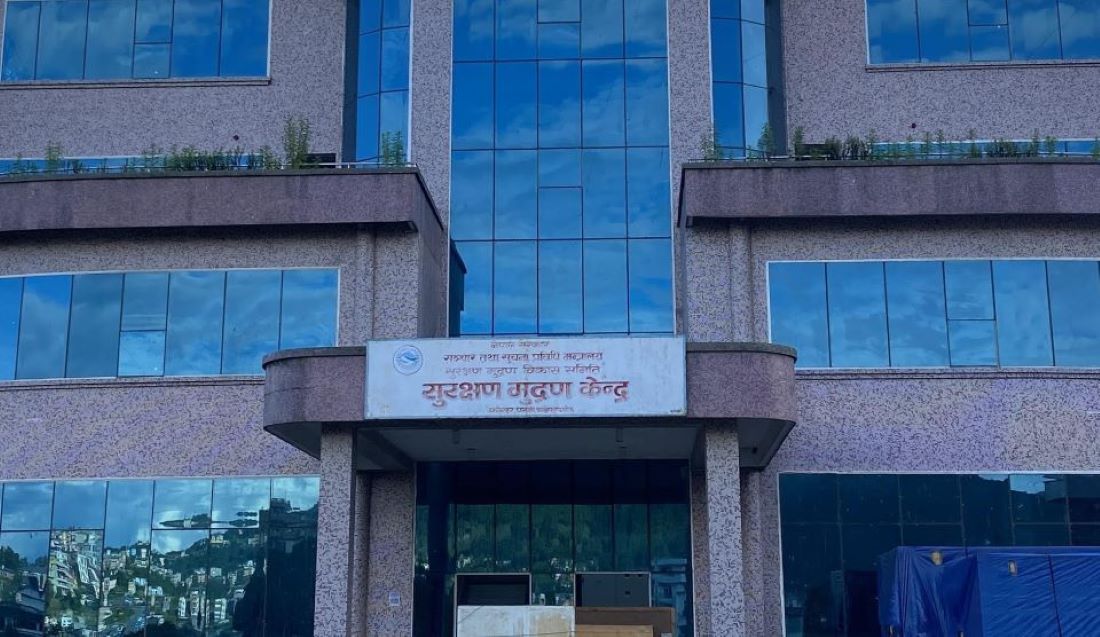
Kavrepalanchok — Nearly 9,000 driving licences with QR codes have been printed in the past two months at the Security Printing Centre located in Panauti Municipality–5, Kavrepalanchok. Since licence printing began at the centre on Kartik 21, a total of 8,983 licences have been printed, according to the Department of Transport Management.
Licence printing had earlier been halted after the department’s “mass printer” was vandalised during the Gen-Z movement. Printing resumed from this centre after Minister for Communications and Information Technology Jagadish Kharel inaugurated the process by pressing the button of the printing press on Kartik 21.
An agreement between the centre and the department for licence printing was signed on Kartik 12. Under the agreement, the centre is required to supply 1.2 million licences to the department within six months.
The department’s IT Director Keshav Khatibada said that 8,983 licences have been printed within two months. According to him, the department has already entrusted the centre with printing 1.2 million licences. At present, around 3 million licences—covering newly trial-passed applicants and renewal applicants—remain to be printed. “Only urgent licences have been printed so far, and out of the nearly 9,000 printed licences, about 7,000 have already been distributed,” Khatibada said.
The department has stated that preparations are underway to print regular licences as well. Khatibada informed that data for 100,000 licences will be sent at once. As per the agreement, the centre aims to complete printing the remaining 1.191 million smart cards within the next two months. Although the work has appeared slow so far, the pace will increase from the month of Magh, said Executive Director of the centre, Devaraj Dhungana. “Since the initial phase was a testing period, only a small number were printed. From next week, the pace of work will increase with additional manpower,” he said.
According to him, internal preparations are underway to print 10,000 smart licences per day starting from Magh. In the first two weeks, 520 licences printed for the first time at the centre were handed over to the department. Dhungana said the licences were delivered after successful testing conducted in a laboratory within Nepal. As per the agreement with the department, 300,000 licences will be printed in the first three months at a rate of 100,000 per month, and the remaining 900,000 licences will be printed in the following three months, making a total of 1.2 million.
The cards printed at the centre use QR codes instead of chips. According to the centre, these cards incorporate high-level security systems. The new cards will use up to six layers of security technology and will contain 34 security features, some visible and some invisible.
In addition to licences, the centre is preparing to print postage stamps, citizenship certificates, excise duty stickers, land ownership certificates (lalpurja), and visa stickers. Earlier, sample excise duty stickers were printed using two highly secure digital machines imported from Iraq. With the two installed machines, up to 6 billion excise duty stickers can be printed annually. Once the press is fully operational, it is expected to save around NPR 10 billion annually that would otherwise flow out of Nepal for secure printing services. The centre will require around 1,000 personnel, including 200 technical staff.
The government prepared an action-oriented and result-based master plan in 2080 BS to develop security printing in three phases. Accordingly, in the first phase, Nepal will become self-reliant within five years. In the second phase, within the next ten years, Nepal will provide reliable security printing services and quality security products to SAARC and Southeast Asian countries. In the third phase, within the next 15 years, the strategy aims to provide reliable security printing services and quality security products to other third countries.
After the physical infrastructure built for the Information Technology Park remained unused, the park was converted into the Security Printing Centre five years ago. Spread over 257 ropanis of land, the park includes two large commercial and administrative buildings, four well-equipped residential buildings, warehouses, and other structures.