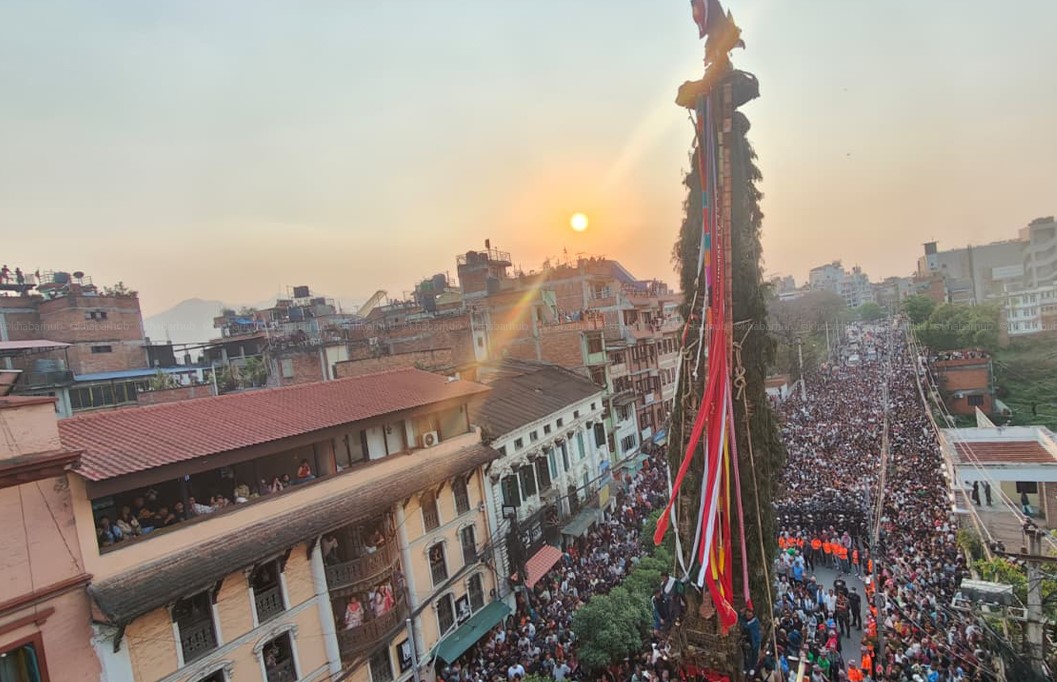
Lalitpur — The centuries-old Rato Machhindranath Chariot Festival, regarded as Nepal’s longest-running cultural and religious festival with a history of approximately 1,600 years, will formally conclude on Saturday following the traditional display of the sacred vest, or Bhoto, in the presence of the Head of State.
According to Santosh Khadka, preparations for the ceremony at Lalit Mandap in Jawalakhel have reached the final stage. As in previous years, the sacred Bhoto will be displayed to both the general public and distinguished guests.
The chariot procession, which began on the first day of the bright fortnight of the month of Baisakh, carried the idol of Lord Rato Machhindranath on a 32-hand-high chariot through Pulchowk, Mangalbazaar, Sundhara, Lagankhel, Kumaripati, and finally to Jawalakhel.
Ward Chairperson Khadka noted that the Bhoto is traditionally displayed on the fourth day after the chariot reaches Jawalakhel.
Cultural experts regard Rato Machhindranath, worshipped as the deity of rain and prosperity, as one of Nepal’s most ancient and distinctive cultural heritages. During the monarchy, the King attended the Bhoto Jatra ceremony, while since the establishment of the republic, the President has participated in the event.
Following the completion of the Bhoto Jatra, the idol of Rato Machhindranath is traditionally placed on an ornate ceremonial palanquin and carried with musical processions from Jawalakhel to Bungamati’s Machhindra Bahal, where it is enshrined.
Khadka stated that this year’s festival has been conducted peacefully, systematically, and successfully. He also urged devotees and visitors attending the Bhoto Jatra to cooperate with security and management arrangements and requested that street vendors refrain from conducting business on the footpaths in the Jawalakhel area.